
The sudden, jarring sound of a tire blowout at highway speeds, the sickening shudder of an engine losing power, or the terrifying crunch of a collision—these are moments that universally induce panic. The reality of driving is that, despite meticulous maintenance and careful attention to the road, emergencies happen. When you are suddenly forced to the shoulder with vehicles rushing past at seventy miles per hour, the resulting surge of adrenaline can easily cloud your judgment. It is completely normal to feel overwhelmed and anxious in these scenarios. However, yielding to panic is the most dangerous thing you can do.
Preparation and a calm, methodical approach are the best antidotes to roadside fear. This comprehensive guide is designed to walk you through the precise, systematic decisions required to manage a severe vehicular failure or accident. Roadside emergencies are highly variable; a minor fender bender requires a vastly different response than a total electrical failure on a pitch-black rural highway.
By memorizing a strict sequence of immediate safety protocols, damage assessment, and proper professional dispatching, you can transform a highly dangerous, life-threatening situation into a safely managed inconvenience. Understanding exactly what to do, what to check, and who to call will protect your life, safeguard your passengers, and prevent further destruction to your vehicle.
Step 1: Secure Your Vehicle and Prioritize Personal Safety
The initial five to ten minutes following a breakdown or collision are arguably the most dangerous. Your vehicle has suddenly become a stationary obstacle in a high-speed environment, drastically increasing the risk of secondary accidents. Your immediate priority is to maneuver out of harm’s way and make your presence unmistakably clear to approaching traffic.
When a vehicle suddenly loses power, the instinct to slam on the brakes is strong, but doing so can be disastrous. Instead, take a breath, maintain a firm grip on the steering wheel, and execute the following maneuvers:
-
Remove your foot from the accelerator and allow the vehicle’s kinetic energy to carry you forward.
-
Signal your intentions immediately and smoothly steer toward the rightmost shoulder.
-
Avoid sudden lane changes; utilize your mirrors constantly to find a safe gap in traffic.
-
If driving at night, aim for a well-lit exit ramp, a rest stop, or a section of the highway illuminated by streetlights.
-
If you cannot reach the right shoulder, aim for a wide grass median, ensuring you are as far from the active lanes as possible.
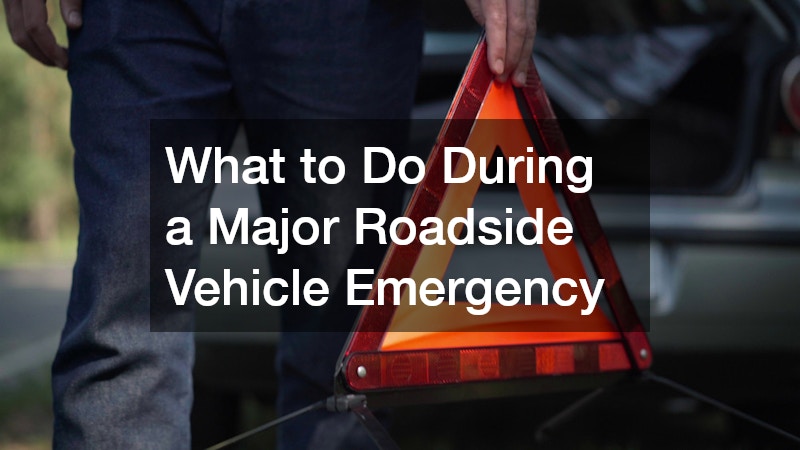
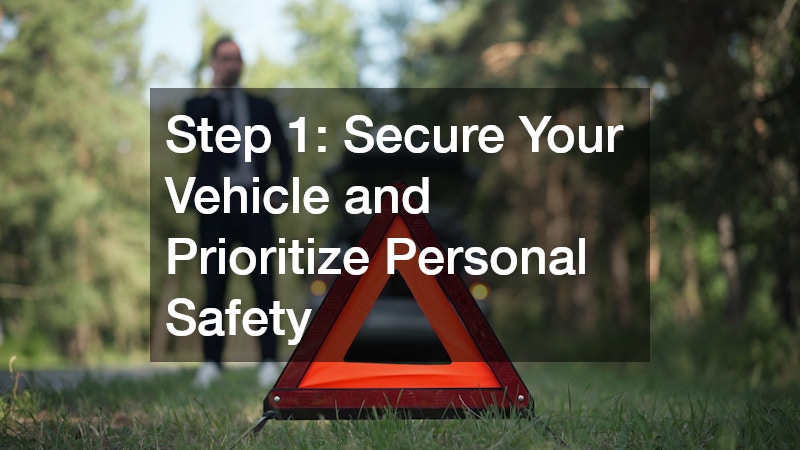
Once you have brought the vehicle to a halt, you must make yourself visible. The primary cause of secondary roadside fatalities is other drivers failing to see a disabled vehicle in time. Activate your hazard lights the moment you realize something is wrong. If you possess early-warning devices, deploy them immediately, provided it is safe to exit the vehicle. Place reflective triangles or LED road flares at staggered intervals behind your vehicle to give approaching drivers ample reaction time. A standard configuration involves placing one device 50 feet behind your car, another at 100 feet, and a third at 200 feet.
Deciding whether to evacuate or remain inside the cabin requires a swift evaluation of your surroundings. If you are stranded on a narrow shoulder with heavy, high-speed traffic whizzing by mere inches from your door, you are generally safer remaining buckled inside your vehicle while you wait for auto towing to arrive. The steel cage of your car offers significantly more protection than standing exposed on the pavement. However, if your car is smoking, or if you are in a location where another vehicle is highly likely to strike yours from behind, exit quickly and safely through the passenger side doors. Step entirely off the roadway and stand behind a guardrail or on an embankment.
When you contact a dispatch center to request extraction, precision is vital. Use the GPS coordinates on your smartphone, nearby mile markers, or distinct landmarks to communicate your exact location. Furthermore, be meticulous when vetting the dispatcher at the towing company to ensure they send the correct equipment. If your vehicle has an all-wheel-drive system or has suffered severe axle damage, a standard wheel-lift truck will cause further mechanical destruction. You must explicitly request a flatbed carrier to transport your vehicle safely.
Step 2: Conduct a Safe Visual Assessment of the Damage
After securing the immediate safety of yourself and your passengers, the next phase is to triage the mechanical and structural state of your vehicle. This must be done cautiously, without ever putting yourself in the path of moving traffic. Your goal is to gather enough information to relay to professionals, not to attempt complex roadside repairs.
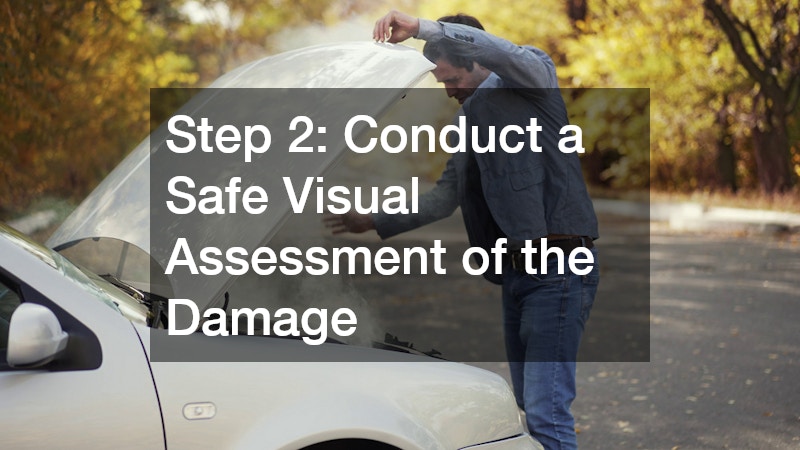
Before inspecting the bodywork or tires, you must rule out immediate life-threatening hazards, primarily fire and toxic leaks. Use your senses of sight and smell to detect imminent danger:
If you have ruled out fire hazards, assess the structural integrity and visibility of your vehicle. A severely compromised car is both illegal and physically unsafe to drive, even for short distances. Inspect the windshield for severe spiderwebbing, deep cracks, or total shatter. If the driver’s line of sight is obstructed, or if the structural integrity of the glass is compromised, the vehicle must not be driven. You will need to coordinate with an auto glass company to replace the windshield before the car is roadworthy again.
Similarly, check the wheel wells and body panels. If crumpled metal is pressing against a tire, attempting to drive will immediately shred the rubber and likely cause a catastrophic blowout. Documenting this scene meticulously is critical for insurance claims and police reports.
Take out your smartphone and capture the following evidence from a safe vantage point:
-
Wide-angle shots showing the vehicle’s resting position relative to the road.
-
Close-up images of all impact zones, deployed airbags, and shattered lights.
-
Photographs of skid marks, road debris, and weather conditions.
-
Pictures of the license plates and insurance cards of any other drivers involved.
This comprehensive visual record will provide undeniable proof of the incident, streamlining your claims process and providing vital information to the auto body shop when it comes time to estimate structural repairs and paint matching.
Step 3: Communicate Effectively with Repair Professionals
Once the vehicle is secure and you have assessed the basic damage, your focus must shift to communication. The accuracy of the information you relay to repair professionals directly impacts how swiftly and effectively you get back on the road. Translating your car’s mechanical symptoms into clear, actionable data ensures that the right help arrives the first time.
If you carry a portable OBD-II scanner in your glovebox, now is the time to use it. Plugging this device into the port under your dashboard will provide specific alphanumeric trouble codes (e.g., P0300 for a random misfire). If you do not have a scanner, you must rely on accurate descriptions. When you call for assistance, do not simply say the car “stopped working.” Instead, describe the sequence of events with precision:
-
Did the engine sputter before dying, or was it a sudden, silent loss of power?
-
Did the steering wheel suddenly violently shake before the blowout?
-
Which specific dashboard warning lights illuminated (e.g., Check Engine, Oil Pressure, Battery, or ABS)?
-
Were there any distinct sounds, such as grinding, squealing, or loud metallic knocking?
Relaying these specific symptoms allows auto mechanics to theorize the root cause before they even see the vehicle, ensuring they prepare the correct diagnostic tools and potentially source replacement parts in advance.
Equally important is specifying the exact make, model, and year of your vehicle. Modern automobiles are incredibly complex, and generic fixes are often detrimental. If you are driving a high-performance or luxury imported vehicle, standard repair techniques might not apply and could even void your warranty. In these instances, you must be proactive and explicitly request specialists trained in European auto repairs. These vehicles often utilize proprietary computer systems, specialized suspension geometries, and unique fasteners that require dedicated tools and specialized training to fix without causing cascading electrical failures.
While you are waiting for recovery services, take the time to contact your insurance agent. Initiating the claims process directly from the roadside can expedite your recovery immensely. Ask your agent to clarify your policy regarding roadside assistance limits, rental car coverage, and whether they require you to use specific approved collision centers. Getting your claim number and coverage details verified immediately reduces out-of-pocket stress later in the week.
Step 4: Handle Emergencies Involving Heavy-Duty and Commercial Rigs
Roadside emergencies take on an entirely different level of gravity when they involve commercial heavy-duty vehicles, tractor-trailers, or large passenger buses. The sheer mass of these rigs, combined with complex powertrain systems, means that standard roadside protocols must be significantly amplified to ensure public safety and effective recovery.
The FMCSA (Federal Motor Carrier Safety Administration) mandates strict protocols for commercial drivers during a breakdown. Because heavy rigs create massive blind spots and require incredibly long stopping distances for approaching traffic, warning signals must be deployed much further out than a standard passenger car.
-
Place the first warning triangle 10 feet directly behind the trailer to signal immediate obstruction.
-
Place the second triangle 100 feet behind the rig in the center of the shoulder or lane.
-
Place the third triangle 100 feet ahead of the cab if on a two-lane road, or 200 feet behind the rig on a divided highway.
-
Always wear a high-visibility, ANSI-certified reflective vest when deploying these signals.
When a commercial rig suffers a mechanical failure, standard passenger car repair solutions are entirely useless. A high-compression engine blowout, an air brake system depressurization, or a locked tandem axle requires highly specialized knowledge. Standard technicians do not have the tools or the training to intervene safely. Fleet managers or owner-operators must bypass standard garages and immediately connect with certified diesel mechanics who understand the intricacies of forced-induction heavy-duty powertrains and pneumatic braking systems.
Minimizing freight downtime is a critical financial concern for commercial drivers. In scenarios involving blown super-single tires, ruptured coolant hoses, or minor air-line leaks, it is often more efficient to coordinate with mobile support units. Dispatching a mobile truck repair service directly to the shoulder can often resolve minor to moderate mechanical issues on the spot. These mobile units carry onboard air compressors, heavy-duty jacks, and common commercial replacement parts, allowing the driver to resume their route without the staggering logistical expense of towing a fully loaded 80,000-pound rig to a service bay.
Step 5: Execute Post-Emergency Checks Before Resuming Normal Driving
The relief of having your vehicle towed or temporarily repaired on the shoulder often leads drivers to believe the crisis is entirely over. However, rushing back into normal driving routines without conducting thorough post-emergency checks can be incredibly dangerous. A roadside fix is often a bandage, not a cure, and severe incidents can cause hidden, compounding damage.
For example, if you were forced to aggressively swerve into a ditch or if you struck a massive piece of road debris to avoid a collision, simply changing the flat tire is not sufficient. The extreme physical force of ditch recoveries and pothole strikes routinely bends tie rods, damages control arms, and misaligns axles. Driving with compromised steering geometry will drastically accelerate tire wear, reduce your braking efficiency, and make the vehicle dangerously unstable at highway speeds. Therefore, it is imperative to book a professional alignment service to inspect the undercarriage, recalibrate the steering column, and ensure the vehicle tracks completely straight before undertaking any long-term driving.
A comprehensive diagnostic review is always recommended following a major breakdown. Ask the technicians to clear the onboard computer codes, test the battery and alternator load, and inspect the engine mounts for stress fractures. For commercial operators, the stakes are even higher. If a heavy-duty vehicle suffered a structural load shift, a blown airbag suspension component, or an impact, a simple visual check is illegal and unsafe. The rig must be taken to a dedicated truck repair shop for a complete, rigorous inspection. This ensures that the frame has not twisted, the kingpin is secure, and the vehicle passes all strict DOT (Department of Transportation) safety sign-offs before hauling freight again.
Finally, take inventory of the supplies you used during the ordeal. A roadside emergency kit is only effective if it is fully stocked. Before you forget, replenish the items that were depleted or damaged.
-
Purchase new LED flares or reflective triangles if yours were broken.
-
Restock the first aid kit with fresh bandages, antiseptic wipes, and pain relievers.
-
Replace used emergency Mylar blankets and hand warmers.
-
Ensure your backup battery packs and flashlight batteries are fully recharged.
-
Restock your supply of bottled water and non-perishable, high-calorie snacks.
Conclusion
Surviving a major roadside emergency requires overriding your natural instinct to panic with a structured, step-by-step plan. The golden rules of any breakdown or collision remain constant: immediately prioritize your physical safety by moving away from active traffic, deploy warning signals to protect others, communicate your exact location clearly to professionals, and cautiously assess the situation without taking unnecessary risks.
While breaking down on a busy highway or a desolate road is deeply stressful, keeping a cool, analytical head guarantees the best possible outcome. By trusting trained professionals and providing them with accurate information, you minimize the time you spend stranded and maximize the chances of a safe, effective recovery.
Do not wait for disaster to strike before you prepare. Take the time today to build or upgrade a high-quality roadside emergency kit, check the pressure in your spare tire, and save key dispatch and insurance numbers directly into your phone’s contacts. Share these critical safety protocols with the newly licensed drivers in your family; the knowledge you pass on today could be the exact information that saves them tomorrow.